Monthly Archives: February 2014

C is for Conjure

IMG_0003
Part of my magical education is in conjure/rootwork/hoodoo/witchcraft (a combination of terms that I take from a series with that title compiled of internviews collected by Harry S Hyatt). I can honestly say I originally came to it back in the early 90’s, mostly in the forms of dollar books about magic, like Marie Laveau’s Black and White Magic and other similar texts. It was also about that time that I first discovered Lucky Mojo and their archives of spells and information, things which amazed me and enchanted me, and also pointed out things like working with Psalms and the bible for magic. Being raised in a thoroughly unusual sect of Christianity that is quite mystical in my opinion, the idea was right on, and I full embraced it.
Later on, much later on, I would find Lucky Mojo again, and memories of it’s first discovery came rushing back to me, and I went to friends that I shared the interest in magic with and I told them “I am going to sign up for Catherine Yronwode’s Correspondence Course” and they said “Oh awesome, we just did, how cool we can work on it together” and I said “WHAT??? You knew about this and you didn’t tell me?!?!?!” and the next day I signed up and everything was awesome. And we would talk about what we read, and what were doing, and where to finds baths, and herbs and everything. It really became the new drink I couldn’t put down, and really still haven’t to this day. It really opened my eyes to a much greater world of magic, of folklore, of herbs then other books, and study had done before.

It also opened my eyes to African American people and culture, and it really made me re-evaluate some of my actions and inner behaviors, that are really just taught across the melting pot of culture in the United States. It set the spark to my flame that wants to know things, to understand things, and see how and where people are coming from, because I just really like to know. I have this thing where I value knowledge for it’s own sake and nothing else. With that in mind, I read other books. I sought out folktales of Southern African Americans, and more of their poetry, both older and perhaps famous, but also contemporary. I read academic publications of people who have researched the interesting and unique combination of folk magic practitioners of African Americans. I set foot in botanicas that are scattered about the Greater Los Angeles area, and became familiar with parts of the African diaspora, so I could learn to identify the difference between a conjure man, and member of an Afro-Caribbean religion, and Mexican folk magic practitioner. I went looking for older pamphlets about spiritual work that are still in print today, because they are regularly popular. During it all I sat down, and I burned candles, and worked with oils, and made incenses and powders and baths from minerals and herbs, and I went to crossroads and gathered graveyard dirt with a dime and bottle of whiskey and I learned to listen to spirits and Spirit.

With all that in mind, I then looked to what seemed to be missing from European stuff (being of European descent) and I found bits and pieces. Reading about hexerei and braucherie, and picking up the Long Lost Friend, and I got into grimories from Europe and made myself read a full translation of the Three Books of Occult Philosophy from cover to cover, reading the footnotes, and looking up terms, and noticing patterns and elements that appeared in the USA among folk magic practitioners, and where they got it, well, they seemed to get it from early merchants of the 20th century whose African American and southern customers who wanted secret symbols, magic squares, blessed salt and john the conqueror roots. I noticed that a lot of herbal folklore was living in Conjure. But yet, it was handled in a unique way. I noticed that in contemporary American alternative spirituality the tools of conjure play and important role, a role that was quickly adopted in the 60’s and 70’s with magic oils, incenses, bathes, washes and colognes with names like “Bend Over” and “Kiss me” but with the neo pagans making their own like “Saturn” and “Goddess” because those neo pagans were hungry for magic and sorcery and witchcraft, and the unique, and the curious, and occult. I think this is a hunger that continues today, which is why people are always finding new ways of doing old things, but also the old ways of doing things, and making all their distinctions, and separate groupings, and traditional crafts, and conure this and hoodoo that because they are curious and hungry for magic. For conjure.
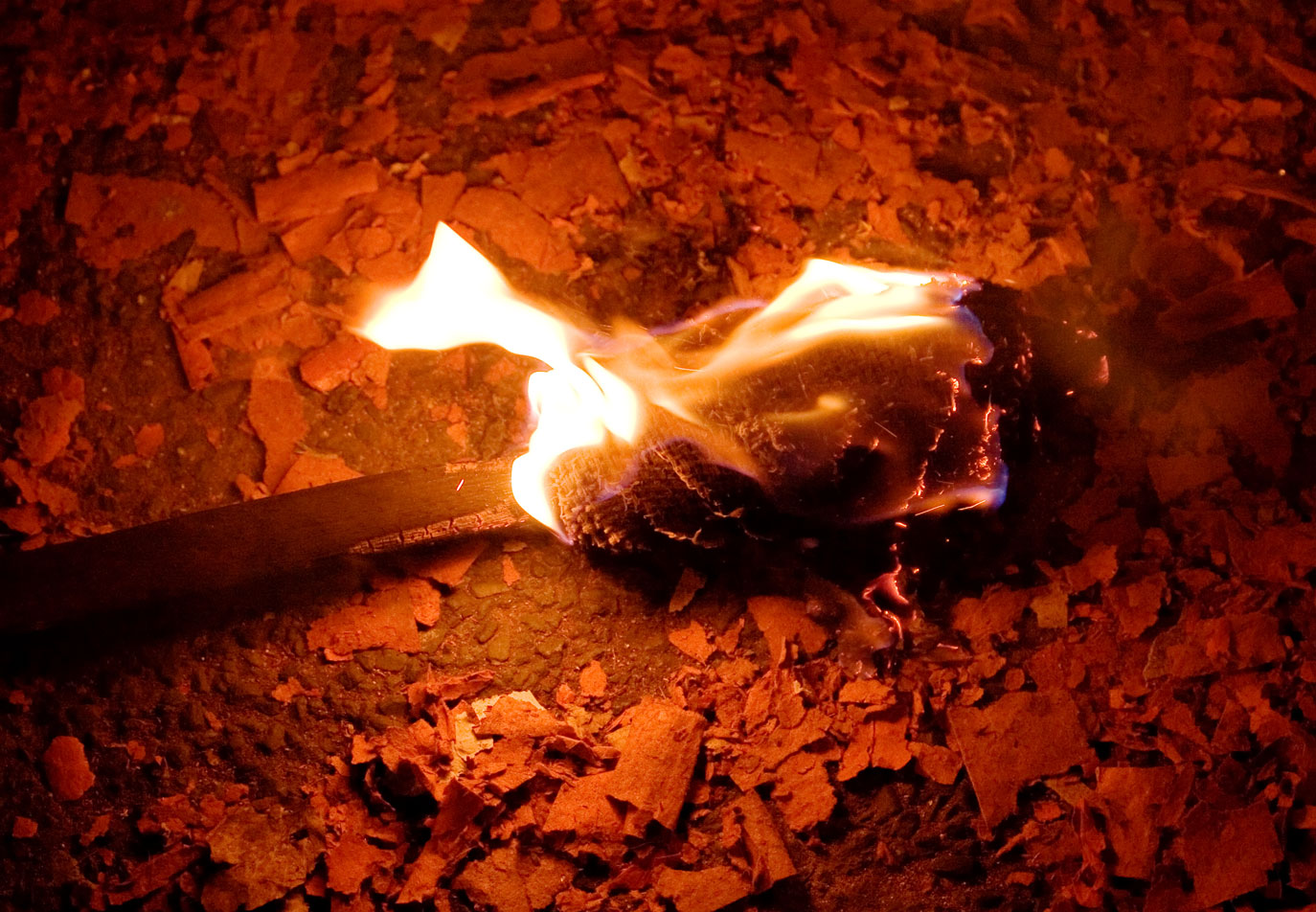

C is for Cenaz

Lewes_Bonfire,_discarded_torch

The rune I like to attribute for the letter C is Cenaz, or just Cen. The symbolism associated with Cenaz is the torch, a piece of wood or metal, that often has some kind of extra fuel source attached to one end, with that fuel source is often some kind of textile that has been soaked in some kind of accelerant or flammable chemical. This allows the torch to be carried around to shed firelight in dark places, either inside buildings that didn’t have windows (and thus no natural light) or in caverns.

As indicated by the symbolism of a torch, this rune is about fire, and light, and things being revealed. In this case though, this is the fire that has been tamed by humanity (unlike qweorth), the light that is wielded by humanity (unlike sowilo), and what is revealed is what is sought by humanity. This colors my interpretation of Cenaz as being the light and fire of humanity, our inspiration, our drive, our passions, that which makes us burn, ignite and shine. While a common symbol for learning, knowledge and education is the lit oil lamp, a symbol that is very Mediterranean, the northern European equivalent would be the torch. You could also extend it to the forge as well, as that is the fire that is harnessed and controlled to create and make things for use by humanity, from basic metal tools to weapons. But that flame is also metaphorical, the flame of passion, the fires of creativity, that spark of an inspiration that sets people on the path to making, making anything from prose to computers.

As I’m writing this, I’m alternating with videos on YouTube, and it occurred to me that these things, music videos, lectures, comedic gags, are that spark of Cenaz at work. Someone had that idea of creating something that would be filmed and made into a video, to express something, or share information that is important to them, or even just to create a laugh, a moment of joyous catharsis. The flame of Cenaz is shining there, revealing something from the creator, but also revealing something to the audience.

My own experience of the spirit of Cenaz was that he was a slim figure, with bright red hair and pale skin, with features like fantasy elves. He was elegant, but crafty and clever and quick with words.

A ritual for Cenaz

what you’ll need
-a red candle
-a candle holder
-any kind of oil that is scented with cinnamon
-a small slip of paper
-red pen

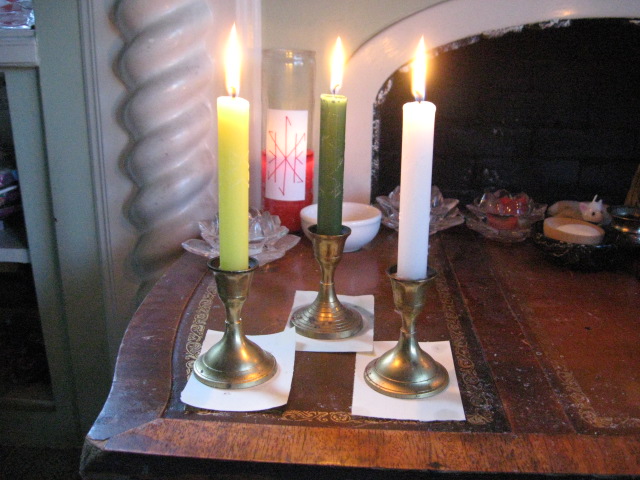
take the slip of paper, and with the red pen, draw the Cenaz rune on it. Then take the red candle, and with a metal implement (pin, needle, nail) carve a Cenaz rune also into it. Anoint the candle with the chosen oil. Some options could be Fast Luck, or Abramelin oil, or a personally made oil that uses cinnamon. Place the candle in the holder, and set the holder on top of the paper. Light the candle, and as it burns chant to your self the name of the rune Cenaz (the C is a hard “k” sound) 9 times. Imagine the flame of the candle beaming it’s light into your eyes and our third eye, and that light sparks a flame inside you. That flame reveals things inside you, revealing your passions, revealing ideas and thoughts for things to do and make, revealing artistic pursuits of all kinds, to forgotten knowledge, events or memories that could be of a benefit to you know. Do this for about 15 minutes. Then snuff the candle with your fingers or a candle snuffer. Repeat this for 7 days in 15 minute increments, until the last day when you should let the candle burn out completely, although before you do so, take the paper form underneath, and burn it in the flame, putting into a fire safe container to burn until it is consumed. Dispose of the ashes by the entrance to your home or building of residence.

B is for Blood

Hot Blood Wallpapers


The inspiration I am having right now seems to be a very potentially a difficult and challenging topic, but, nothing is else is coming to mind, so here I go.


Blood.  It makes quite a few people very squeamish.  I know I dread getting shots or giving blood, but sometimes it needs to be done.  But blood also was a part of more then a few ancient traditions, and often in different ways.


The most significant and seemingly enduring symbolism of blood is life.  Because when a human being, or an animal is cut or pierced, they bleed and this red fluid comes out, and if enough red fluid comes out, that person or animal dies.  And so, anything that has a red fluid, or could be used to produce a red fluid like substance, became symbolic of this red fluid that seemed to be the vital fluid and liquid of life.  Thus trees that produce red sap, minerals that could produce red pigments, plants that would produce red dyes, and everything else that would produce red. Because of the primal, atavistic recognition of the importance of blood, red is probably one of the three most long lasting and widely used colors, the others being white and black.


Over time, the importance and value of blood and it’s life power became recognized in various cultures.  In ancient burials, people’s bones would be rubbed or dusted with red ochre, perhaps as sign or significance of their blood returning to the earth, or with the thought that they might rise up again, perhaps has a spirit, or being reborn. The word “bless” actually comes from a root word meaning blood, as the method of blessing things in some culture was to sprinkle the blood of sacrificed animals upon them, either items or people.  In modern Northern European paganism, they celebrate “blots” which originally referred to the offerings of blood that were involved in such events.


Because of the  significance of blood, who had control of it’s spilling, and also its source, became very important and controlled especially when it came to humans.  Many ancient cultures probably had laws governing menstrual blood.  While there are still continuining examples today, such as Orthodox Judaism, Islam, and Hinduism, although some of the countries where these religions operate have deemed those laws to be unfair and unequal to women (which they are) some people still follow them out of tradition.  Thus women become set aside during their menstrual period.  I suspect this was widespread through the ancient west, as Agrippa makes note in the 3 books of Occult Philosophy that menstrual blood, and even the shadow of menstruating woman was deemed to be very hazardous and even dangerous to everyone around them, as it might blight crops, stop cows from milking, kill lesser animals, and bring infertility to other women and impotency to men.  A very different viewpoint from most modern paganism, which has been strongly influenced by feminism and the movement to bring justice and equality to women.
The other image of blood, supported by the movie industry, is of course one of human or animal sacrifice, usually portrayed as horrific act involving torture and barbarous methods of butchery for the target involved.  While in most things I have read, it seems less and less likely that ancient mediterranean cultures did practice human sacrifice, there is still documentation of it occuring in other parts of the world, although usually in very special and specific cases.  While in most of the Western World, animal sacrifice is also gone to a certain degree (outside of Kosher and Halal traditions) in Africa, and the african diaspora, Animal sacrifice plays a role, and blood is often the key part of the sacrifice.  As blood is considered the vital essence, it is that which is usually offered to the gods and spirits, whereas the muscle maybe kept and cooked and distributed to the community to eat and feast.  Unlike in horror movies, the sacrifice is usually done respectfully , with very little suffering, and is more like a ritualized method of butchering the animal then the horror movie shocker of torture, mutilation and waste.
An example of offering blood from ancient Sparta  was in a ritual to Artemis.  One of her priestess would hold her image, while men would take a whip and beat the new young men, until the blood flowed freely down their backs.  If the image grew heavy, the priestess would say so, as that was a sign that the man was holding back, as he favored the young man and wished to lessen the harm.  This was a ritual to propitiate Artemis’ wrath for the grave insult that was done to her by the Spartans.  Originally they thought she wanted them to kill one of the young men, but realized that only their blood was needed, so the scourgings began instead.  After being scourged, the young man was officially a man, and no longer a boy or youth.


There is some people who given blood in modern practices.  Some of them are reconstructionists, trying to recreate the pagan past as honestly and correctly as they can. Others might be unallied to any particular group, but following intuition and inspiration, will give their own blood, or perhaps blood collected from butchers.  The easiest way to give your own blood is with diabetic needles, as they are often sold sterilized, and really all you need is just a drop.
Another way you can give blood though is more metaphorical.  The phrase “blood, sweat and tears” as a sign of hard work and effort put into a project would be a fitting offering to the Gods and spirits that you seek a relationship with.  This “blood” is often just as acceptable, or even more so then physical blood in this day age.

B is for Berkana

Because I spent I good deal of time talking about two other runes that relate to trees, it only feels appropriate that the only B rune should be talked about.

Berkana

Berkana is often translated as birch, a tree that most people are probably passingly familiar with. It has white bark, which often is seen peeling off during certain parts of the year, which seems similar to some kinds of paper, and in fact people did use to write on birch bark for somethings and probably still do, I think it is the white bark of most birch trees that probably stands out the most in my mind, as that much stark lack of color is very distinct, especially when it is off set with many green leaves.
birch-tree1
The esoteric symbolism of birch and berkana is what is usually focused on. The meanings that I have always ascribed to it is growth, healing, nurturing, becoming, life changes, and liberation. My own meditations and journeys with this rune have pointed to the powerful feminine influence. My own experience of the spirit of Berkana is as the Birch mother, female spirit with pale skin and green hair, who dwells in a endless forest of birch, with light shimmering through the leaves of the forest.

In part of the tree pattern that seems apparent in the runes, Berkana is the world tree as the generative, creative aspect. In the history of the world, the birch was the first tree to emerge in open areas, quickly turning an area that was an open meadow into a forest, and as the glaciers retreated further north, birch trees would continue to follow, while other trees may then fill in the areas that had once been filled with birch. In the Anglo-Saxon rune poem, it is even described as just growing from suckers that the parent tree spread from it. Although now days research has shown that is not actually a birch tree or a member of the betula family, the concept of prodigous generative power carries forward in the rune.

A is for Aegishjalmur

IMG_0002

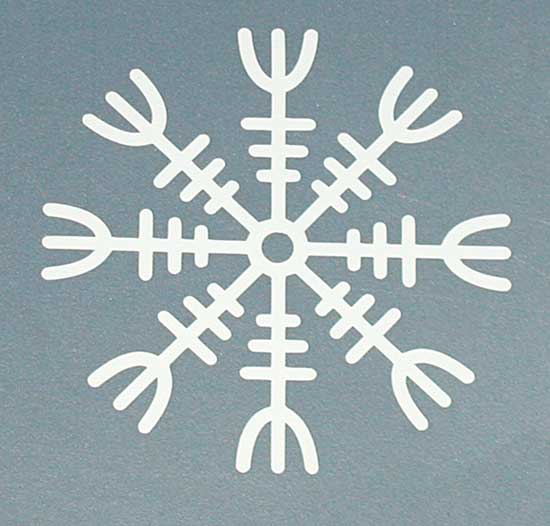
I’m sure most people who are interested in this sorts of things will be somewhat passingly familiar with the aegishjalmur, and it’s also most common appearance.  However, there are quite a few variations on that form, and they were used for a good number of things from looking at various spells and entries in Icelandic magic of the middle ages.

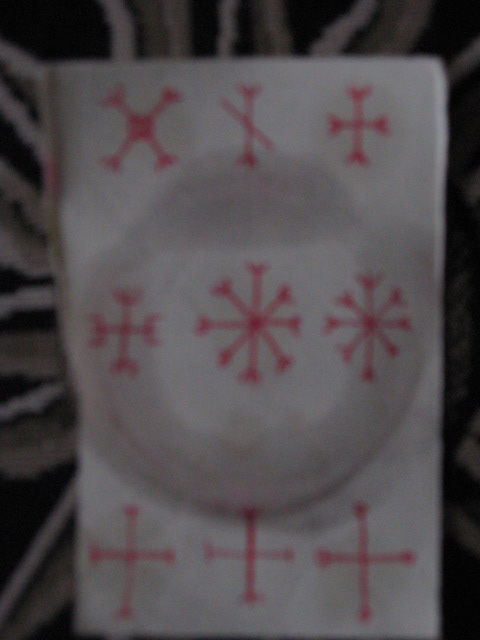
This particular version, shown above, is one of my favorites.  The name  of these is aegishjalm arnirniu (I’m sorry, I don’t quite know how to put accent marks in there, so I apologize for their absence) which is translated as the Nine Helms of Aegir.  The text associated with them says “These are the nine helms of Aegir that everyone who deals with knowledge cannot do without. Each of them should be used.”


Following these directions, I put them all down on a piece of paper, in red ink, and proceeded to use that as petition paper that would I burn candles on (thus the waxy circle on the paper, yes this is a photo graph of the actual talisman).   As there is no further directions given, I just laid them all out as I felt was aesthetically pleasing, and using oils and incense with them as it relates to wisdom, knowledge, and mind empowerment.


Here is a spell.


What you’ll need

-a purple candle

-a wisdom oil (King Solomon’s Wisdom, or just Wisdom etc…)

-incense (wisdom incense if you can, but just frankincense or copal will do in a pinch.  You can could also burn sage leaves)

-a candle holder

-piece of paper

A piece of solomon seal root

-red pen


Take the piece of paper (something about 2×4 inches will be fine) and using the red paper, write the 9 helms of aegir on the paper. Put it however you want, but there should probably be a helm in each corner and a helm on each side with one helm in the middle.


Using the Wisdom oil and your finger, dab a small amount of oil on to each helm.


Take the solomon seal root, and fix it with the Wisdom oil.
Take the purple candle, and anoint it with Wisdom oil.  Do this however you prefer anoint candles. Set the candle in the holder, and place the holder on top of the piece of paper. ( I find a good brass holder is good for this purpose.) If you can, place the Solomon seal root under the candle holder, on top of the paper, or place it next to the base of the holder.


Light some charcoal, and put it into your censer, brazier or whatever you burn charcoal in.  Put a good pinch of incense on the charcoal and let it smoke.  Light the candle wick and let it burn.


As the candle burns, you should pray.  You might recite mantras for wisdom, recitations from Psalms or Proverbs.  You can also pray silently, and allow the Wisdom of God or the Gods, or the ancestors to come to you and fill you.  You could also meditate.


You can do this spell in one day, by letting the candle burn down. You could also repeat it for 7 days, burning the candle in 15 minute increments, snuffing it each day with your fingers or a candle snuffer, until the 7th day, where you should let it finish burning.


Take the solomon seal root, and put it into a flannel bag of either white, purple or red, along with the paper with the nine helms on it.  Carry it with you, or place it under your pillow as you sleep, keep it on a secure place on your altar or wherever you keep your altar.  Whenever you are doing your daily practice of prayer, you should take it, and wear the bag, or sit with it while you do your daily prayers or meditation.

A is for Runes

A starts off quite a few runes, ones that I particularly enjoy. So lets begin

Aethel
Aethel – while different rune sets may spell this rune differently, I prefer this spell. It reminds of certain pagan scandinavian government practices called the Athling, the meeting of all people in Iceland to discuss law, property and punishment for people. It was in fact at an Athling that the icelandic people chose to become Christians, back in the day, and afterwards, abolished the Athling. Go figure.

But anyway, Aethel. Aethel, to my understanding of runelore, is the rune of home, homeland, and family, expressed in the form of the family property passed down from generation to generation, and so it also connects in deeply to the ancestors. Your ancestors, usually and specifically the ancestors of blood. Of course, living in the 21st century, sometimes knowing your ancestry and ancestors can be difficult, as families are now widely scattered over great areas, and you don’t always live within a few miles of your cousins, aunts, uncles, grandparents, and it seems far more people are having children later in life, rather then earlier (although it still happens) children may not be old enough to remember or meet grandparents, or even great grandparents. With that in mind, it can also signify what I like to think of all your ancestors, whether it’s from a spiritual tradition, or your adoptive family, or a connection based on skills, background, culture or subculture, many many things that make up the web of life, that unite us in a chain or connection that goes back to the very beginnings of the cosmos. Some might even call that link the river of blood, symbol of the blood of humanity, but also the blood of living things that evolved to become us, and that river even flows on to what the world and it’s inhabitants might become. Ancestors.

Ac
Ac – An Anglo-Saxon rune, what I see as the beginning of the 4th aettir, Ac means Oak, and of course, ir refers to the Oak tree, that mighty and revered tree that many people admire, adore, and in some cases venerate. This rune belongs to a body of runes that are different trees, which to me suggests some kind of importance to trees and people’s relationship with them, as well as perhaps some kind of tree cult.
Part of my understanding of Ac, from the it’s meaning of Oak, is the idea of endurance. Some of the oldest and mighties of trees are often oak trees, that have stood of centuries, if not longer. Even in some areas they are called Grandfather Oak. It’s also surprising how different oak trees can be from environment to environment. While most oak trees are deciduous, in California (where I live) there is the California liveoak, an oak tree that never loses it’s leaves, much like evergreen trees, but yet, it’s an oak. It does that because of the mediterranean climate. But like many other oaks, liveoaks live for very long time, get quite large, and seem to be able to take a licking and keep on growing. Thus, endurance. The ability to sit tight, and hold on, and weather time, and drought, and storms, and to keep growing, not to wither, or falter or fade.

Aesc
Aesc – in the 4th aettir, this rune follows right after Ac, and is also a tree rune. In this case, it’s the tree Ash. The only ash tree I’m familiar with is the shamel ash, but there are quite a few varieties, and they are all wonderful trees. They can grow quite tall, and it seems, be very leaf and make great shade trees. Interestingly enough, the rune poem associated with Aesc, seems to comment on how high the grow, and that is the key thing I notice when working with Aesc, namely that it reaches up to heaven. In some of the lore of World trees, Ash is often mentioned, along side the Yew, and of course Oak. My as all those trees make appearances in the runes, I see them as showing different aspects of the world tree, that cosmic center and pillar which supports all things. The Ash is the heavenly side, the side reaching up to sky, connecting with the upper world, and the powers that dwell there. With Aesc, we can scale up to meet them, or they might be reaching down to knock us on the head and get our attention. Of course, when that connection is broken, all hell can break loose, as we run around, not thinking things through, not acting from a place of Wisdom, or Compassion, and we might pretty soon make a big mess of things.

Fascination and the Aegishjalmur


The power of fascination or enchantment is one of the more commonly given powers associated with practitioners of magic.  Yet, it seems to be the least mentioned ability in many books dealing with magic.  The only sources that I have yet to find that deal with it are Agrippa (in his classic 3 books) Paul Huson in Mastering Witchcraft, and Jason Miller in the Sorcerer’s Secrets.  It is such a useful technique; it is surprising that so many people seem to ignore it.


For myself, I have found that the aegishjalmur, or the helm of awe (or terror), is a most useful symbol in working this kind of magic, both in a general way and in working with the specific application when interacting with a specific person.  I also combine the aegishjalmur with the ideas and techniques presented by the three authors above, so it makes it a pretty effective tool in my bag of tricks.


When you are first starting out, I highly recommend actual putting the aegishjalmur on your forehead.  A method described in the galdrabok indicates doing so with your own spit, so work up a good mouthful of saliva (you’ll need it) and using your left index finger, put the aegishjalmur on your forehead. It’s not going to be perfect, so don’t try to make it that way. When you are finished, press your index finger into the center of the symbol and say:


“The helm of awe is upon my brow. Let all strife be stemmed, let all wrath be run away, Let all people look upon me with favor, as the Lady looks upon the Lord with favor and may the world and land be gracious as friends.”


Channel some ond into the symbol and then continue on about your day.  You could also use an appropriate condition oil to put the symbol on your forehead, but I find that makes me break out, and having facial blemishes doesn’t really help one in social interaction.


This is the basic set-up for working with the aegishjalmur and using it for persuasion and influence. When it comes time to work on someone specifically, well, you should already have done this.  When you find yourself entering into a situation where you want the influence of the helm, start channeling ond into the figure on your forehead.  Feel it light up with energy, and start glowing, and that glow starts to wrap itself around you. As you continue to power it, you should also start to feel it acting upon the third eye and perhaps feel ond flow into the subtle channels of the eyes from there.  I find that with fascination, eye contact is important.  The ond that will radiate from the eyes will carry emotions and desires with it, and for it to “hit” it needs to meet the eyes of the desired target.  So, make eye contact.  Often times the eye contact will instantly get the attention of the target once it is made, because in this day and age it seems eye contact is something that many people avoid.  Depending upon how you want to influence the target, try and keep your face relaxed but  following the general intention, i.e., try a subtle smile (practice it) if you are trying to entice the person, and do a subtle frown or tighten your jaw a little if you’re trying to intimidate the target.

Once you have the target’s gaze (even if for a second) then continue to move forward.  Play a game of cat and mouse, where you are present, but just out of reach.  Talk to them briefly, but then indicate you need to go elsewhere (to friends, refresh your drink) to give them space, but then return after a few minutes.  If you find the opportunity presents itself, give them an acceptable and friendly touch.  The touch should also be charged with ond and your intention, whether it is a handshake or an “accidental” tap with the elbow against their elbow or arm.  Of course, if all is going well, they should be paying rapt attention to you, and find ignoring your difficult.  If your goal is to get into close contact/quarters with the target, once that occurs, start delivering ond with your breath, your gaze and your touch, all channeled through the helm of awe.

Runes of Love

IMG_0001

Love spells! Everyone wants love spells. When it comes to doing magic, often time when clients come many a reader, sorcerer or spiritual worker, they are looking for love, either to get new love, re-gain love that has been lost, or move a current love into a new situation, such as marriage. Of course, part of the field of Love spells, also includes spells that promote harmony among people, from married couples to families and communities.
It often seems to me that Love magic is the ignored part of working with runes. Maybe a footnote here, or a value given there, but in many books dealing with runes and rune magic, Love is often overlooked, although that maybe the prior trend of the “unpopularity” of love magic with the Neo-pagan movement. However, it’s pretty clear from some surviving written lore, that spells that promote love and harmony were definitely part of the Northern Tradition. I would like to turn to the Havamal in this case, and the runes described by the speaker.

The first stanza that identifies a spell dealing with promoting love (or in this case harmony) is the stanza of the eigth rune:

An eighth I know: which all can sing
for their weal if they learn it well;
where hate shall wax ‘mid the warrior sons,
I can calm it soon with that song

Where the hate and conflict among kin can be soothed through singers magic skill. The second stanza identifying love magic is the sixteenth rune:

A sixteenth I know: when all sweetness and love
I would win from some artful wench,
her heart I turn, and the whole mind change
of that fair-armed lady I love.
And the seventeenth:
A seventeenth I know: so that e’en the shy maiden
is slow to shun my love.
Being the clearest examples of what is recognized as love magic. Of course the singer indicates his mastery in the this art, as he is able to win the love of not only other skillful women, but even young shy women who are often harder to obtain.
To this end, I looked to the runes, seeking and identifying which runes resonate with the powers of love, harmony, and relationships. With my research I identified nine runes, which can be worked, separately or together, in master the arts of love magic.

In the ordering of the futhorc aettirs, the first rune identified is Kenaz. Kenaz, the torch, is the fires of passion. They ignite the feeling inside, a flame that reveals the desires, but also burns. The burning passion leaves little peace, until they have been satiated.
The next rune is Gebo. In Gebo we see the exchange of relationships, partnerships, the agreements, the contracts, the idea of dowry, union of people and the rules that govern that union. Gebo is the most unromantic side of love magic, the side that comes after “and they all lived happily ever after” which people often want to forget. It is having the skills in this side that make relationships succeed or fail, and being able to manage the give and take successfully will often help in being successful in whatever partnership is entered into.
The third rune of love is Wunjo. Joy is it’s name, and joy can be a wonderful, if temporal thing. This is one of the first runes I identify with harmony among people, although in this case it is usually familial harmony. The conflicts between spouses, between parents and children, between siblings, can all create a very unharmonious and dissonant environment. Wunjo is the joy and peace of happy family, and a happy familial home. It’s dark side can be the grasping for this temporal thing. When everything is sacrified, just so that one can maintain the illusion that life is free from strife, the grasping for joy can become a toxic quest, and the peace is shallow, and soon shattered.
Interestingly enough, a whole aettir is skipped here. I studied this for a while, but part of my understanding of the second aettir, the aettir of Hagal, is that it is the runes of warrior, and conflict. While there are runes here that might be useful in influence and command (which has sometimes role in the world of love spells) they are not really concerned with love per se, but with having influence over other people, to any end.
The fourth rune is Berkana. In Berkana is the love of a mother for it’s child in sense. It is nurturing, supportive, and steady. It is also powerfully feminine, which can be somewhat hard to describe exactly how. It is the rune of Women, and express the powers of women, not just girly, but also Amazonian. The mysteries of Women who Love Women are found in this rune, which has it’s own draw, but it can also be used by women to draw whatever kind of love they desire, especially when combined with other runes, or to heal a womans sexual nature, if it has been damaged or cursed.
The fifth rune is Mannaz. In Maanaz, there is the coming together of equals, or rather the marriage of equals. While the rules of marriage belong to Gebo, means of relating to each other are found in Mannaz. This marriage of equals also governs friendship, the brother and sister-hood of humanity. This rune promotes the harmony of whole communities, but also individual people. This is love without lust, just a simple affection, which flows out from within. The idea that comes to me is that deep within each person, there is Love, and when this love is allowed to expressed freely, without expectation of return, or demands, is when people can get along innocently.

The sixth rune is Inguz. As Berkana is to feminity, Inguz is to masculinity. It is a great power, that lies dormant, until it is triggered and released, bring strength and setting change in motion. It can be aggressive and rough when needed, but mostly it is strong and solid. It is the rune of Men and in many ways directly relates to the phallus. It is not only the usual masculine stereotype, but also the gentle man, who can be strong, but sensitive. It also contains the mysteries of Men who Love Men, but it can be used by all men to attract Love, and also sex. It can also helping curing the damaged sexual nature of men, whatever their orientation.
The seventh rune is Ac, the mighty Oak tree. In the permanence and endurance of Ac is fidelity, the ability to stay the course and endure the trials of Love. While many love spells used to promote fidelity were the domain of women who livelihood often depended upon the fidelity of their husbands, who if they could get to stay at home night, at least to make sure they come home when they are done. Fidelity is also about staying together, “for richer or poorer, in sickness and in health.” Sometimes the stress of living can sow the seeds of discontent between partnered couples, and it may take the patience of the partners to rise above their own trials, and embrace their partner(s). In exchange, it also buries jealousy, as I was taught growing up that “jealousy is the grave of affection” and being able to stand fast by your partner, when perhaps they are succeeding, and your own efforts are impeded or faltering can be a difficult thing.
The eighth rune is Ior. Ior is the rune of boundaries and finding happiness within those boundaries. Sometimes, that happiness is found by transgressing what is perceived as binding us, but sometimes it is also recognizing that boundary helps us to nurture ourselves and find our own happiness, wherever it maybe. Happiness is an amorphous thing, and constantly changes. What feeds your happiness today, is not what fed your happiness yesterday, and may not sustain your happiness tomorrow. Being able to change, adapt, and move between environments, elements, or even worlds is a survival skill, that opens up opportunities to find new resources that can sustain you.

The ninth rune is Khalk. Khalk is the cup of desires, the loving cup which contains all that one can want. Contained within the wondrous draught is the fulfillment of our hearts content, yet the difficult part is getting the drink. It can show you what it is you really seek, from this person, from this relationship, from this moment, but it can also make you that which is sought. Glamor was the popular word used for such thing, the magical gilding which brings out the best in each person, showing them as the desired prize, yet keeping it just unattainable enough that they want it all the more. Khalk proves the desire is not about being the best looking, but having the confidence to show your worth.

Having worked with these runes in love magic over the past couple of weeks, I can tell you, yeah it works, quite well. My first experiment was working with each rune, to see how they would manifest. Over the course of nine days, combining the runes with other love-drawing methods (red candles, condition oils, and galdr) those nine days were some of the more interesting escapades in love that I have had.

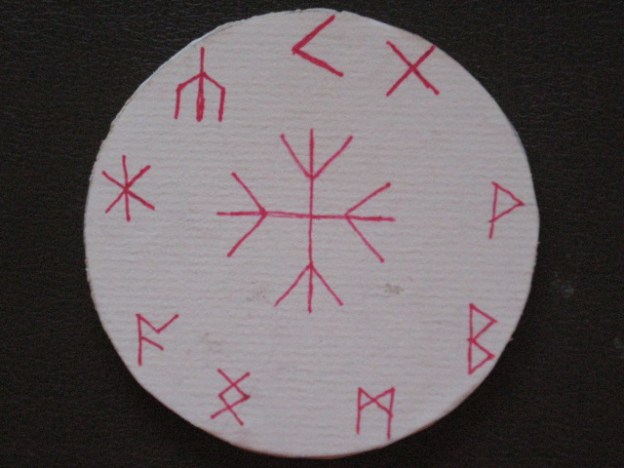
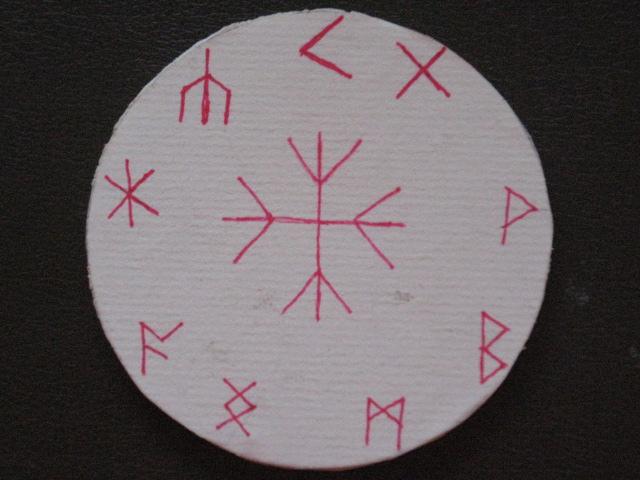
The image with this post is a Love rune talism that I created when working with this, a simple disc with the runes inscribe in a circle around. The image in the middle is an aegishjalmur described in the Icelandic grimoire, that will get you the love of the person you desire.

Aegishjalmur

aegishjalmur

The Aegishjalmur or Helm of Awe is probably one of my favorite symbols from the Northern Tradition. It is one of the magical signs that have many forms and seems to appear often, especially in the Icelandic galdrbok as a means to gain many things, from stilling anger, to winning love, or just having the favor of men or removing anger. Some variants are very simple images, others are as complex as solomonic and goetic talismans in their imagery. I personally have a preference for the simpler ones, mainly because they are much easier to inscribe on a multitude of surfaces.

The helm of awe is even mentioned in the sagas, probably the most famous saga, The Volsungasaga. The dwarf turned dragon, Fafnir, bears a helm of awe, which is one of the means that he keeps his suspected foes away from the treasure that he has accumulated.

Later, in the galdrbok tradition, it is suggested that the aegishjalmur symbol be made into lead and pressed between the brows, or using spit, drawn on the forehead. One version has an incantation that reads

“It is the helm of awe that I bear between my eyes-wrath runs away, strife is stemmed. May every mother be delighted with me as Maria was delighted with her blessed son when she found him on the rock of victory, in the name of the Father, and the Son, and the Holy Spirit” followed by “ Olvir, Odhinn, Evil One/ All will you bewitch! / May God himself, with skill/ Send love between us two!”

This was used to still wrath, but also could be used to bring love.

A variant aegishjlamur was named Solomon’s Insigli aka Solomon’s sign and was used for protection.

The main purpose of the Helm of Awe in my works is for success, victory, mastery and favor. You could use spit and other traditional means to place it upon your brow, but you can also use relevant condition oils (such as Crown of Success, Master or High John the Conqueror).

A simple Aegishjalmur spell for success could consist of the following:

A yellow candle (for success, victory and favor)
Crown of Success condition oil
Crown of Success sachet powder
Crown of Success incense
A piece of paper (parchment paper or hand torn brown paper)
A red pen
A pin or needle
Quick lighting charcoal
Incense holder

Light your charcoal.

Take the piece of paper, and using the red pen, draw the aegishjalmur symbol on the piece of paper. Sprinkle a small amount of sachet powder on the paper and symbol, and then retrace the symbol with your left index finger. When you finish, snap the paper to remove the sachet powder.

Take the yellow candle. With the pin or needle, carve the aegishjalmur symbol into the candle. Dress the candle with Crown of Success oil, and place it over the symbol and paper. Put some incense on the charcoal. As it is smoking, using spit or oil, make the draw the aegishjalmur on your forehead, when completed say:

“The Helm of awe is upon my brow. Let all people look upon me and hear my words with favor, as the Lord looked upon his creation with favor, that I may succeed in all my works. So It is!

Light the candle and let the candle burn down to completion. After it has burned out, carry the paper with you in your wallet or purse, as talisman for success and favor. If you desire, you can take the talisman and press the symbol to your forehead and repeat your incantation, while you are out to strengthen the aegishjalmur.